Teaching Clothes, Weather and Seasons to Kids: Fun ESL Activities and Printables
How do you teach clothes, weather and seasons in English without turning them into three separate vocabulary lists children quickly forget? In this article, I'm sharing playful ESL games, movement activities and printable worksheets that help preschool, kindergarten and young learners connect words like coat, sunny, winter and T-shirt with real situations, simple English instructions and hands-on activities they can actually understand and remember.
These topics work especially well together because children already understand the basic connections from everyday life. When it is cold, they know they need warmer clothes; when the sun is shining, they can think about summer, shorts or a T-shirt; and when it starts raining, a jacket or umbrella suddenly makes sense. English therefore becomes a way of describing situations they already know rather than a list of unrelated words.
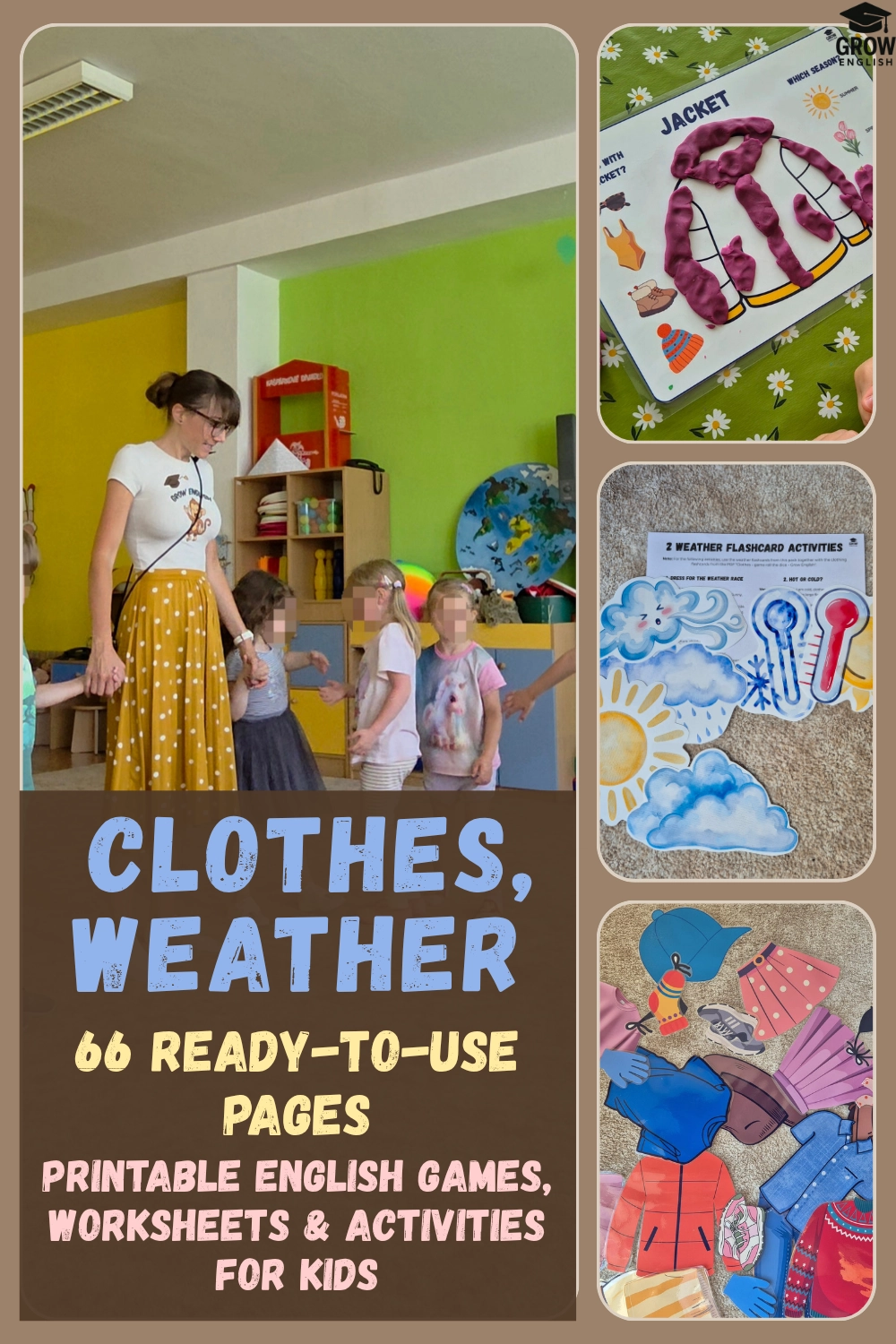
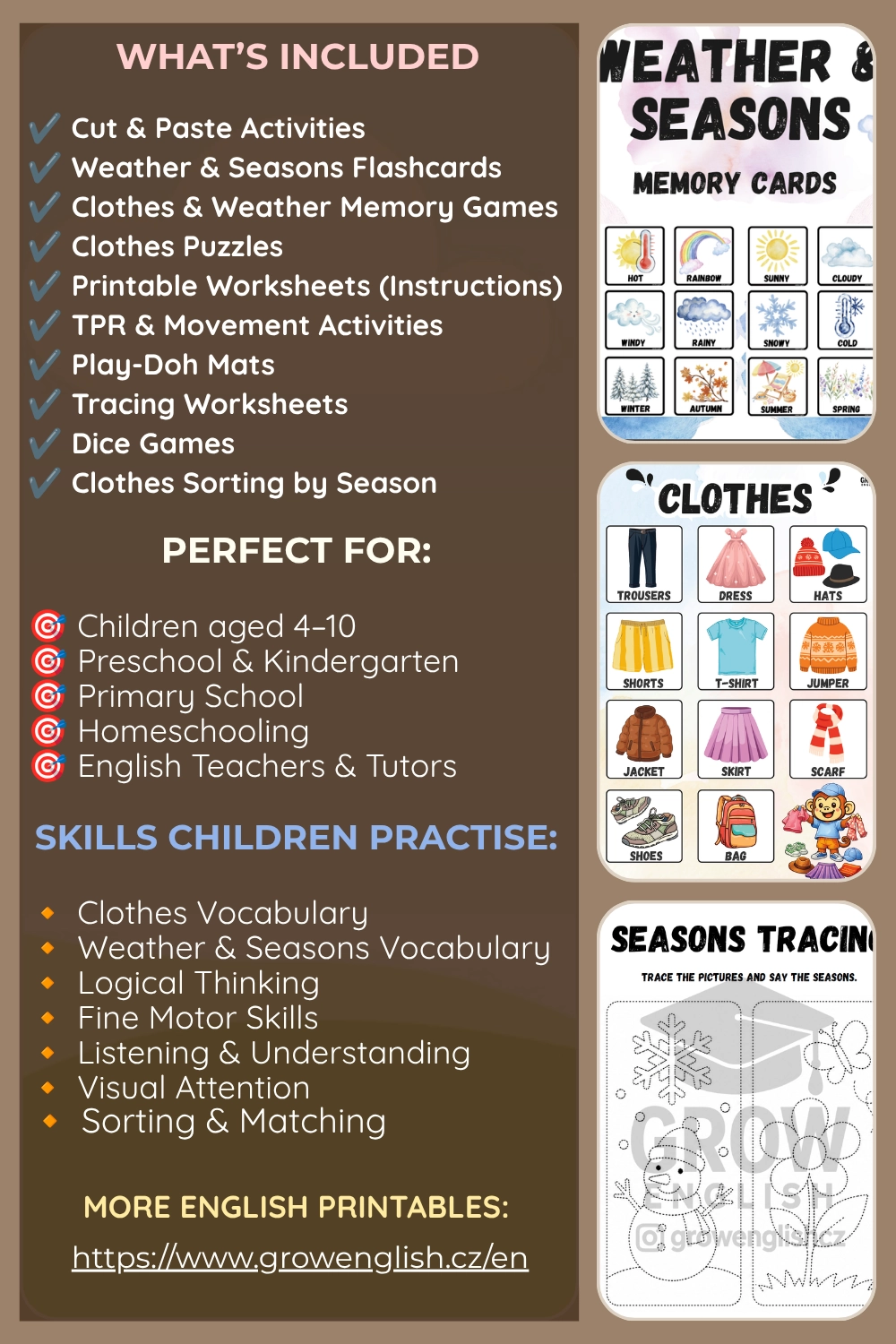
If you would rather have several lessons prepared in advance, my Clothes, Weather & Seasons Printable Pack contains 14 PDFs and 66 pages of ready-to-use flashcards, games, puzzles, memory cards, worksheets, Play-Doh activities and other materials that can be used across several lessons without preparing every resource from scratch.
Why teach clothes, weather and seasons together?
Young children rarely experience these themes separately in real life, so it makes sense to connect them in English as well. A child already understands that winter can be cold, that cold weather usually means a coat, hat or gloves, and that summer brings a completely different set of clothes.
That gives us a much more natural way to build vocabulary. Instead of teaching coat, winter and cold as three unrelated words, we can gradually put them together into a complete idea:
It is winter. It is cold. I am wearing a coat.
Once children begin to see these connections, the words become easier to understand and remember because they are tied to a familiar situation rather than to a single flashcard.
The same principle also allows us to bring back vocabulary from earlier lessons. A hat can become a blue hat, socks can become two red socks, and before long children can follow instructions such as Find two blue hats without feeling that they are learning a completely new topic.

Introducing clothes through real objects and flashcards
Flashcards are useful when introducing new clothes vocabulary, but I prefer to use them as a starting point rather than as the whole lesson. Children may first meet words such as T-shirt, dress, jacket, coat, scarf, gloves, boots, shoes, shorts and hat through pictures, but once the vocabulary becomes familiar, the same cards can be reused in several different ways.
We can spread them around the room and ask children to run to the item they hear, sort them according to the weather or season, hide one card and ask What's missing?, or combine them with real clothes so that children can touch and handle the vocabulary they are learning.
I especially like using real clothes with preschool learners because the language immediately becomes more concrete. Looking at a picture of a scarf is useful, but actually holding one, putting it on and hearing This is a scarf makes the word much easier to connect with meaning.
At first, very simple questions are enough:
What is it?
What colour is it?
Is it for summer or winter?
Younger children may answer with a single word, while more confident learners can gradually move towards phrases such as a red scarf, a blue jacket or It's a hat.

Dressing games: listening and reacting to English
One of the easiest ways to turn clothes vocabulary into real language is to let children actually put the clothes on.
I prepare a few easy-to-use items, usually slightly larger pieces that children can quickly pull over their own clothes, and then give simple instructions such as:
Put on the red scarf.
Put on the blue hat.
Put on the green T-shirt.
The child has to listen carefully, recognise both the clothing word and the colour, choose the correct item and react to the instruction.
Once the group knows the basic vocabulary, I make the task a little less direct and give them a situation instead:
It's raining. What do you need?
It's winter. Put on something warm.
It's hot and sunny. What can you wear?
Now children are doing more than identifying a word. They are connecting weather, clothes and meaning and deciding which item makes sense in the situation.
The most useful moment comes when children stop waiting for a translation and simply react to what they hear.
This type of activity can also be adapted very easily. With younger learners, I keep the instructions short and often demonstrate the first few examples. With older or more confident children, I can add colours, numbers or two-step instructions such as Put on the blue hat and take the red scarf.

Hot or cold? Giving clothes vocabulary a reason
A simple sorting activity can make clothes vocabulary much more meaningful because children have to think about when and why we wear particular items.
I place two cards on the floor, I am hot and I am cold, and then give the children pictures of different clothes. Their task is to decide where each item belongs.
A scarf or gloves will probably go with I am cold, while shorts and a T-shirt will go with I am hot. The activity becomes even more useful when the answer is not completely obvious, because children then have a reason to think, compare and explain.
The English can stay very simple:
Are you hot or cold?
What do you need?
Would you wear gloves?
Is a T-shirt for hot or cold weather?
For preschool children, choosing the correct card is already a valid response. They do not need to produce a complete sentence immediately; understanding comes first, and speaking can grow from that later.

Summer or winter? Connecting clothes with seasons
Once children understand the difference between being hot and cold, it becomes much easier to connect clothes with the seasons. I usually start with summer and winter, because the contrast is clear enough even for very young learners and children can immediately bring in their own experience.
We can place two large cards on the floor and ask children to sort clothes according to when they would most likely wear them. A pair of gloves naturally belongs with winter, while shorts or a T-shirt make more sense with summer.
As the children become more confident, I start asking simple questions instead of telling them where each item belongs:
Would you wear this in winter?
Is this for summer or winter?
What do you wear when it is cold?
What do you wear when it is hot?
There does not always have to be only one perfect answer. A jacket, for example, may work in more than one season, and those small moments of uncertainty are actually useful because children have to think about meaning rather than simply matching a card to a predetermined category.
Later, we can gradually add spring and autumn, but I prefer introducing them once children are already confident with the basic contrast between hot and cold weather.

Weather through movement
Weather vocabulary becomes much easier to remember when children can connect each word with an action. Instead of only showing a picture of windy or rainy, I like to let children move in a way that represents what they hear.
For windy, they can sway from side to side or wave a light scarf through the air. For rainy, they can tap their fingers like falling raindrops, and for sunny, they can stretch their arms upwards towards the imaginary sun. If we are practising cold, children can hug themselves and shiver, while hot can be shown by pretending to fan their faces.
At first, I demonstrate the movements together with the group, but after a few rounds I stop and simply call out the weather:
- It's windy!
- It's raining!
- It's sunny!
- It's cold!
- It's hot!
If children respond with the correct movement, I can immediately see that they understand the language without asking them to translate anything.
Children do not always need to say the word to show that they understand it. Sometimes the right movement tells us much more.
This kind of movement game also gives us an easy opportunity to revisit colours. If the children are using scarves, I can say Take the blue scarf, Wave the red scarf or Give me the yellow scarf before we even begin the weather activity.

Clothes puzzles and memory games: calm activities for vocabulary practice
After movement-based activities, I often like to slow the lesson down without changing the vocabulary we are working with. Clothes puzzles and memory games are perfect for this because children can concentrate, match pictures and think about the words they already know while the lesson naturally becomes calmer.
With clothes puzzles, children look carefully at the pictures, find the matching pieces and put each clothing item together. While they work, I keep the English simple and connected to what they are doing:
What is it?
Can you find the other half?
What colour is it?
Is it for summer or winter?
Once the picture is complete, younger learners can simply name the item, while more confident children can use a short phrase such as a red jumper or It's a jacket. The finished puzzles can also be sorted by season or weather, so the same material can be reused later instead of being limited to one matching activity.
Memory games work in a similar way. At first, I may use only clothes cards, but once children know more vocabulary, I can add weather and seasons so that they naturally move between several connected topics while playing. A beginner might turn over a card and say coat, sunny or winter, whereas a more confident learner can gradually move towards It's a coat, It's sunny or It's winter.
The same cards can also be used for What's missing?, sorting clothes according to the season, matching clothes with different types of weather or simple speaking practice. With older children, I sometimes ask an extra question when they turn over a card:
When do we wear it?
What season is it?
What is the weather like?
This is what I like about both puzzles and memory cards: the materials can stay the same while the English around them gradually becomes more challenging, which means we can return to them across several lessons without the activity immediately becoming too easy.


Play-Doh clothes: one activity, several topics
Play-Doh works particularly well when I want children to slow down while still keeping the English active. Instead of simply looking at a picture of a T-shirt, jacket or hat, they can actually create the item themselves, which gives the vocabulary a much more concrete meaning.
While they work, I keep the language connected to what they are making:
What are you making?
What colour is it?
Is it for summer or winter?
Would you wear it when it is cold?
A beginner may simply answer jacket, while a more confident learner can gradually move towards a blue jacket or It's for winter. The same activity can also bring back familiar colours and numbers without turning them into a separate exercise.
For example:
Make two red socks.
Make a blue hat.
Add three buttons.
That is exactly what I like about hands-on activities: children are focused on creating something, while English becomes the language around what they are doing.
A good hands-on activity gives children something to think about while English becomes the language around what they are doing.
If your learners already know some basic colours and numbers, this is an easy way to bring that vocabulary back naturally. You can find more ideas in Colours in English for Kids and Numbers 1–10 in English for Kids.


Listening and colouring: more than a colouring worksheet
A colouring worksheet can become a useful listening activity very easily if the child does not simply choose all the colours independently.
Instead, I give short instructions such as:
Colour the T-shirt blue.
Make the hat red.
Colour the shoes green.
Now the child has to understand both the clothing word and the colour before doing anything on the page, so the worksheet becomes a listening task rather than only a quiet colouring activity.
With younger learners, I keep the instructions short and give them one at a time. With older or more confident children, I can gradually combine more information:
Colour the T-shirt blue and the shoes red.
Find the winter clothes and colour them green.
This is one of the easiest ways to revisit colour vocabulary inside a different topic without making the lesson feel repetitive.

Seasons and early pencil skills
Season-themed tracing activities can also serve more than one purpose, especially with preschool learners. Children can practise pencil control and hand-eye coordination while we continue talking about spring, summer, autumn and winter.
I do not expect young children to write long English words simply because we are learning the seasons. Instead, the worksheet can focus on fine motor development while the English remains mostly oral.
We can ask:
What season is it?
Is it hot or cold?
What can you wear?
What colours can you see?
If the picture contains familiar shapes, we can bring those words back as well, which gives us another simple way to recycle vocabulary children have already met.
If your learners already know basic shapes, you can continue with Shapes in English for Kids, where I share more movement games, hands-on activities and printable ideas.

Bringing familiar vocabulary back again and again
One thing I try to avoid with young learners is treating every new topic as if the previous one has finished and disappeared. Clothes, weather and seasons actually give us a perfect opportunity to recycle vocabulary children already know and use it in a new context.
A simple instruction such as Find two blue hats combines numbers, colours and clothes, while Put the red scarf next to the yellow circle brings shapes into the activity as well. Children are not learning completely new language every time; they are learning how familiar words can work together.
This kind of recycling is especially useful with beginners because repeated exposure makes vocabulary more secure without turning the lesson into constant drilling.
If you are building the same foundation with young learners, you can continue with my articles Colours in English for Kids, Numbers 1–10 in English for Kids and Shapes in English for Kids, where I share more games, movement activities and printable ideas.
The more often children meet familiar vocabulary in a new situation, the more naturally they begin to understand and use it.
Ready-to-print Clothes, Weather & Seasons activities for several lessons
Preparing this topic from scratch can take much longer than it first seems, because one worksheet is rarely enough if you want children to practise through movement, listening, sorting, matching, speaking and quieter table activities.
That is why I created the Clothes, Weather & Seasons Printable Pack, which contains 14 PDFs and 66 pages of ready-to-use materials for young English learners. Instead of preparing a new activity before every lesson, you can choose from flashcards, memory games, puzzles, Play-Doh mats, sorting tasks, tracing worksheets and other activities depending on what your group needs that day.
The idea is not to use all 66 pages at once. One lesson may need a quick movement game, another may work better with a matching activity, and on a quieter day you may prefer tracing, colouring or Play-Doh. Having the materials prepared simply means you can revisit the same vocabulary in different ways without creating everything again from scratch.
If you would like Clothes, Weather and Seasons prepared for several lessons in advance, you can find the complete pack in the GROW English Printables section.
Teaching English through connections children already understand
Clothes, weather and seasons may look like three separate vocabulary topics, but for children they naturally belong together. A child already understands that winter can be cold, that cold weather may mean a coat and gloves, and that summer usually brings something completely different.
When English begins to describe situations children already know, the language stops feeling like a list to memorise and starts becoming something they can actually understand and use.
The goal is not to collect more vocabulary words. It is to help children connect the English they know with the world they already understand.